 Onlive Server
18 hours ago in Technology & IT Services
High Authority Social Bookmarking Site for Canadian SEO in 2026 - A2Bookmarks Canada
A2Bookmarks Canada is the premier Canadian social bookmarking site designed to help you save, organize and share favorite web pages. Our social bookmarking platform for Canada makes it easy to manage important links while connecting with other users across top Canadian social bookmarking sites. As one of the leading social bookmarking sites in Canada for 2026, we offer tools to strengthen your digital presence and grow your business online. Elevate your Canadian SEO strategy by bookmarking content for local audiences, increasing relevance across social bookmarking platforms in Canada. Optimize your search rankings with targeted backlinks and community engagement on Canada's fastest-growing bookmarking network. Share, categorize, and promote links to build authority and drive quality traffic. Join our Canadian social bookmarking community today to make your online experience more efficient and connected.
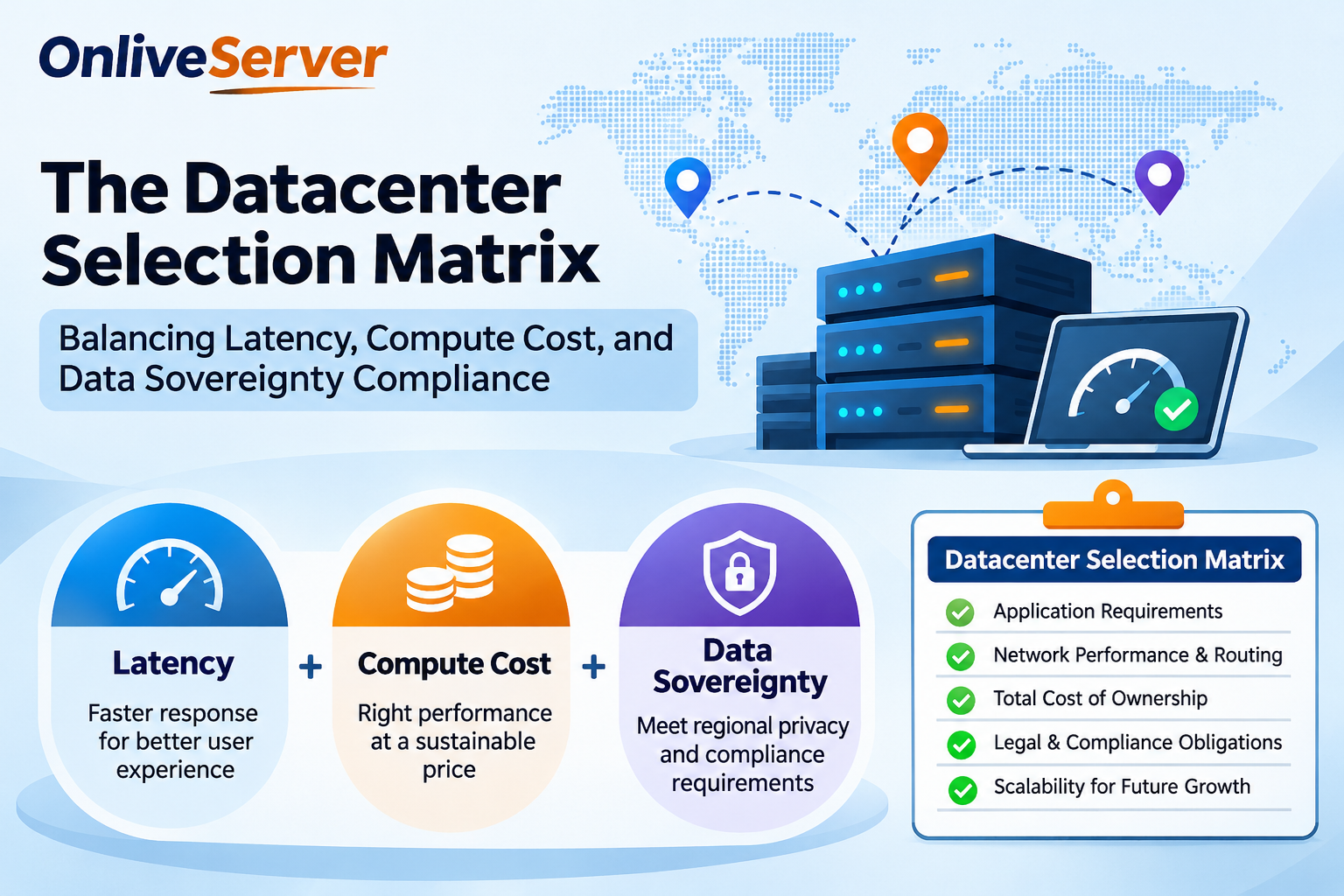
The Datacenter Selection Matrix: Balancing Latency, Compute Cost, and Data Sovereignty Compliance
Onlive Server
18 hours ago in Technology & IT Services
Choosing the right VPS server location is an important infrastructure decision for businesses operating websites, applications, and digital services. The location of a datacenter affects network latency, hosting expenditure, application responsiveness, and how organizations manage customer data under different privacy laws.
A datacenter close to customers may provide lower latency, but it might also have higher infrastructure costs. Another region may offer affordable computing resources while introducing additional network delays or regulatory considerations.
Understanding how to choose VPS server location requires balancing these factors against actual business requirements.
A structured datacenter selection matrix allows IT managers, cloud architects, and procurement teams to compare hosting regions based on performance, cost, compliance, reliability, and scalability.
Why Datacenter Location Matters for VPS Hosting
Datacenter location affects VPS performance because geographic distance, network routing, and connectivity influence server response times. Applications such as e-commerce platforms, financial dashboards, and database-driven websites may experience higher latency when servers are located far from users. However, the nearest datacenter is not always the fastest, as network quality and routing efficiency also matter. Businesses should compare actual latency, hosting costs, and compliance requirements before choosing a VPS server location.
Three Key Factors in VPS Datacenter Selection
1. Network Latency and User Experience
Network latency measures the time data takes to travel between users and servers, usually in milliseconds (ms). Lower latency improves application responsiveness, especially for businesses serving customers across multiple regions. Tools like Ping, Traceroute, and MTR help measure network delays, routing efficiency, and connectivity issues. When choosing a VPS location, businesses should test performance from different geographic regions and consider server processing speed, database efficiency, and network reliability rather than focusing only on the lowest latency.
2. Compute Cost and Infrastructure Pricing
VPS hosting costs vary by region due to electricity prices, hardware availability, network infrastructure, and market demand. When comparing datacenter locations, businesses should consider CPU performance, RAM, storage speed, bandwidth, backup charges, and data transfer costs rather than monthly pricing alone. A cheaper VPS may offer weaker processing power or limited disk performance, affecting application speed and reliability. Choosing a VPS with the right balance of cost, performance, and resources provides better long-term value.
3. Data Sovereignty and Regulatory Compliance
Data sovereignty determines which country’s laws apply to the storage and processing of personal information. Businesses choosing a VPS location must consider privacy regulations such as the European Union’s GDPR, which sets requirements for data protection and international transfers. Transferring personal data outside the European Economic Area may require safeguards such as Standard Contractual Clauses. Hosting data within Europe does not automatically ensure compliance, as organizations must also maintain proper security, access controls, and lawful data processing practices.
Philippine Data Privacy Act of 2012 and Offshore Hosting
The Philippine Data Privacy Act of 2012 (Republic Act No. 10173) requires businesses to protect personal information through appropriate security measures and responsible data processing. The law generally allows offshore data storage and processing, provided organizations meet applicable privacy requirements. Under Section 21, businesses remain accountable for personal data transferred to third-party providers. When choosing a VPS datacenter outside the Philippines, companies should review data protection agreements, access controls, backup locations, and international transfer safeguards before considering hosting costs.
VPS Datacenter Selection Matrix: Comparing Five Operational Criteria
A practical decision matrix helps organizations evaluate candidate datacenter regions consistently.
The following framework identifies five important considerations.
| Selection Criteria | Evaluation Method | Business Importance |
| Network latency | Test RTT, routing stability, and application response time | Critical for interactive workloads |
| Compute cost | Compare CPU, RAM, storage, bandwidth, and recurring expenses | Important for budget planning |
| Data compliance | Review privacy laws, contracts, and transfer requirements | Mandatory where applicable |
| Infrastructure reliability | Examine redundancy, backups, availability, and recovery capabilities | Critical for production systems |
| Scalability | Assess upgrades, resource availability, and regional expansion options | Important for future growth |
The matrix should reflect actual business priorities.
An international online store may assign greater importance to application performance and uptime.
A financial services organization may prioritize regulatory requirements and information security.
A development team running non-production workloads may focus more heavily on affordable computing capacity.
Mandatory compliance conditions should be treated as eligibility requirements rather than optional scoring factors.
Once unsuitable locations are eliminated, the remaining regions can be compared using weighted scores.
When Should Businesses Accept 30ms Higher Latency?
Choosing between lower latency and affordable VPS hosting depends on application requirements. A server with 40ms latency may offer faster responses than one with 70ms, but the additional 30ms delay may be acceptable for background tasks or less time-sensitive applications. For applications requiring multiple server requests, delays can accumulate and affect performance. Businesses should compare hosting costs, actual response times, security, and compliance requirements before deciding whether lower pricing justifies higher latency.
Four Non-Negotiable Criteria for Financial Data Hosting
Organizations handling customer financial information should establish minimum infrastructure requirements before purchasing VPS hosting.
Regulatory eligibility
The selected location must satisfy applicable privacy rules, contractual commitments, and relevant financial-sector requirements.
Information security
The environment should support appropriate encryption, restricted administrative access, security monitoring, vulnerability management, and incident response.
Data location transparency
Businesses must understand where customer records, database replicas, backups, and disaster recovery copies are stored or accessed.
Operational continuity
Infrastructure should provide suitable backup arrangements, recovery procedures, and availability capabilities for business-critical services.
A datacenter failing any mandatory requirement should not be selected solely because it offers lower monthly prices or improved network performance.
Single-Region vs Multi-Region VPS Deployment
Single-region VPS hosting is suitable for businesses serving customers in one geographic area, offering simpler management and lower operational complexity. For companies with international users, multi-region VPS hosting can improve performance by placing application servers closer to customers. Content delivery networks (CDNs) can also reduce loading times for cached content. However, multi-region deployment increases costs, database management complexity, and compliance requirements. Businesses should choose multi-region hosting only when its performance and availability benefits justify the additional expenses.
How to Choose the Right VPS Server Location
Choosing the right VPS server location starts with understanding customer geography, application requirements, and expected traffic. Businesses should compare datacenters based on network latency, routing stability, server performance, hosting costs, and data compliance requirements. Testing connectivity from different regions helps identify the most suitable location, while reviewing backup costs, bandwidth, and scalability supports better long-term planning. For more details, explore VPS Location and Latency Guide.
Security Considerations Beyond Server Location
Datacenter location alone does not guarantee VPS security. Businesses must protect their servers through regular operating system updates, firewall configuration, strong authentication, restricted access, and continuous monitoring. Secure backups, encryption, and reliable recovery procedures are equally important for protecting customer data. Following VPS Server Hardening and Security Tips can help organizations strengthen server security regardless of their chosen datacenter location.
Final Thoughts
Choosing the right VPS datacenter requires balancing network latency, hosting costs, reliability, and regulatory compliance. The closest or cheapest server location may not always provide the best performance or long-term value. Businesses should evaluate application response times, infrastructure expenses, data security, and regional privacy laws before making a decision. A structured datacenter selection matrix helps organizations choose a reliable, cost-effective VPS location that supports current operations and future business growth.
voters
Report Story 
Related Stories











Recent Stories